
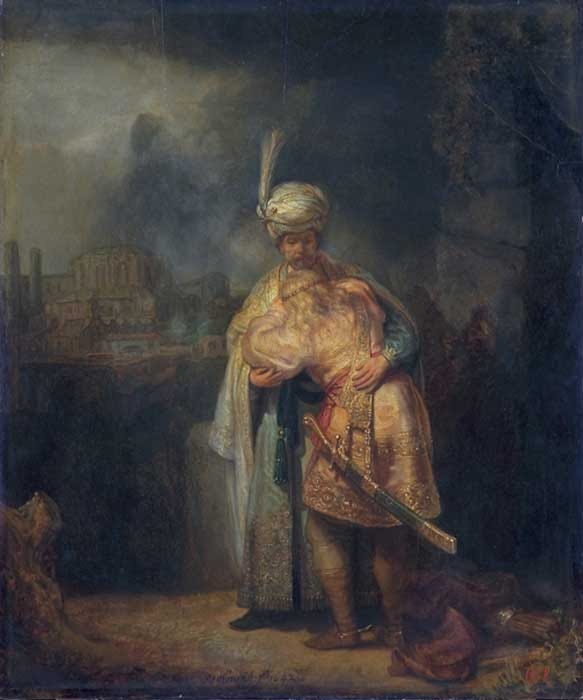
Biblical and Literary Insights on Deep, Meaningful Relationships in an Individualistic Age
Friendship has fallen out. We live in a culture that prizes radical individualism. C.S. Lewis says that friendship and love have no primal urge.
“Without Eros none of us would have been begotten and without Affection none of us would have been reared; but we can live and breed without Friendship. The species, biologically considered, has no need of it. ”
We see in books and movies examples of sexual love and familial love. We see fewer and fewer examples of friendship and love. Sixty years ago, Tolkien and Lewis, who were close friends, offered many examples of friendship. Of these many examples, one of the most profound examples of Biblical friendship is seen in the friendship that Samwise Gamgee and Frodo Baggins have for each other in JRR Tolkien’s epic work Lord of the Rings.
One of the clearest examples of friendship in The Lord of the Rings. At the end of their journey to Mount Doom to destroy the ring of power. The journey and the burden of the ring have so weighed down Frodo that he can no longer walk; he can only crawl.
“Now for it! Now for the last gasp!’ said Sam as he struggled to his feet. He bent over Frodo, rousing him gently. Frodo groaned; but with a great effort of will he staggered up; and then he fell upon his knees again. He raised his eyes with difficulty to the dark slopes of Mount Doom towering above him, and then pitifully he began to crawl forward on his hands.
Sam looked at him and wept in his heart, but no tears came to his dry and stinging eyes. ‘I said I’d carry him, if it broke my back,’ he muttered, ‘and I will!’
‘Come, Mr. Frodo!’ he cried. ‘I can’t carry the ring for you, but I can carry you and it as well. So up you get! Come on, Mr. Frodo dear! Sam will give you a ride. Just tell him where to go, and he’ll go.’
“As Frodo clung upon his back, arms loosely about his neck, legs clasped firmly under his arms, Sam staggered to his feet; and then to his amazement he felt the burden light. He had feared that he would have barely strength to lift his master alone. and beyond that he had expected to share in the dreadful dragging weight of the accursed Ring. But it was not so.
Whether because Frodo was so worn by his long pains, wound of knife, and venomous sting, and sorrow, fear, and homeless wandering or because some gift of final strength was given to him, Sam lifted Frodo with no more difficulty than if he were carrying a hobbit-child pig-a-back in some romp on the lawns or hayfields of the Shire. He took a deep breath and started off.
He had expected to share in the dreadful dragging weight of the accursed Ring. But it was not so.
This is a perfect picture of friendship, as we will see in our text today. It’s also something each of you has experienced. You have faced hardship, and you will face hardship, and the only way you will survive those difficult seasons is not through rugged American individualism but God-given dependence on others.
Jonathan Edwards, in a sermon on envy, said the only possible reason the first human being was lonely in the garden of Eden, that paradise wasn’t enough for that first human being, is that God made us need others besides himself. In fact, Jonathan Edwards says God must be the least envious, least possessive person in the whole universe because he designed and deliberately made us need others besides himself.
God put man in a garden surrounded by beauty, but he was alone, and God said that was not good. For a man to fully reflect his creator, he needed another to have a relationship with as God has within himself.
We live in a culture that is obsessed with eros – sexual love. In fact we have so hypersexualized our culture that our kids only know how to have boyfriends and girlfriends because we have forgotten how to be friends. We make every relationship same-sex and opposite-sex sexual. In modern America, there is so many things that have created ease and comfort in so many ways compared to life here 200 years ago. It was much more difficult, but they had something we didn’t. They had a friendship that was not always sexualized.
To the Ancients, Friendship seemed the happiest and most fully human of all loves; the crown of life and the school of virtue. The modern world, in comparison, ignores it.
C.S. Lewis
Covenantal friendship is not something that is optional in the life of a Christian. It is something that reflects the person of Christ and the God that we serve.
1 Samuel 20:1–17 (ESV)
Jonathan Warns David
20 Then David fled from Naioth in Ramah and came and said before Jonathan, “What have I done? What is my guilt? And what is my sin before your father, that he seeks my life?” 2 And he said to him, “Far from it! You shall not die. Behold, my father does nothing either great or small without disclosing it to me. And why should my father hide this from me? It is not so.” 3 But David vowed again, saying, “Your father knows well that I have found favor in your eyes, and he thinks, ‘Do not let Jonathan know this, lest he be grieved.’ But truly, as the Lord lives and as your soul lives, there is but a step between me and death.” 4 Then Jonathan said to David, “Whatever you say, I will do for you.” 5 David said to Jonathan, “Behold, tomorrow is the new moon, and I should not fail to sit at table with the king. But let me go, that I may hide myself in the field till the third day at evening. 6 If your father misses me at all, then say, ‘David earnestly asked leave of me to run to Bethlehem his city, for there is a yearly sacrifice there for all the clan.’ 7 If he says, ‘Good!’ it will be well with your servant, but if he is angry, then know that harm is determined by him. 8 Therefore deal kindly with your servant, for you have brought your servant into a covenant of the Lord with you. But if there is guilt in me, kill me yourself, for why should you bring me to your father?” 9 And Jonathan said, “Far be it from you! If I knew that it was determined by my father that harm should come to you, would I not tell you?” 10 Then David said to Jonathan, “Who will tell me if your father answers you roughly?” 11 And Jonathan said to David, “Come, let us go out into the field.” So they both went out into the field.
12 And Jonathan said to David, “The Lord, the God of Israel, be witness! When I have sounded out my father, about this time tomorrow, or the third day, behold, if he is well disposed toward David, shall I not then send and disclose it to you? 13 But should it please my father to do you harm, the Lord do so to Jonathan and more also if I do not disclose it to you and send you away, that you may go in safety. May the Lord be with you, as he has been with my father. 14 If I am still alive, show me the steadfast love of the Lord, that I may not die; 15 and do not cut off your steadfast love from my house forever, when the Lord cuts off every one of the enemies of David from the face of the earth.” 16 And Jonathan made a covenant with the house of David, saying, “May the Lord take vengeance on David’s enemies.” 17 And Jonathan made David swear again by his love for him, for he loved him as he loved his own soul.
What is the narrator telling us? “Eugene Peterson, who is a commentator on this passage, says this. It’s a very, very poignant, I think, observation. He says, in short, during this most dangerous, evil chapter in all of David’s life, this deep friendship with Jonathan bracketed the evil. That’s quite an insight. Literally, of course, in the narrative, in the story, the friendship with Jonathan is the bracket at the beginning and at the end.
What is Peterson saying? What are we learning? What we’re learning is the friendship with Jonathan literally contained the evil. It didn’t just drown David. It made it containable. It made it bearable. It made it survivable. He never would have made it, literally. He would never have survived without his friendship with Jonathan.”
Tim Keller
How does the passage redefine friendship for us.
1. Transparent In its actions –
1 Samuel 20:17 (ESV)
17 And Jonathan made David swear again by his love for him, for he loved him as he loved his own soul.
1 Samuel 18:1 (ESV)David and Jonathan’s Friendship
18 As soon as he had finished speaking to Saul, the soul of Jonathan was knit to the soul of David, and Jonathan loved him as his own soul.
1 Samuel 20:17 and 1 Samuel 18:1 say they were one in spirit and say Jonathan loved David as his own soul. To be one in spirit means friends are transparent with each other. That is, they open to let you see in. They open to let you see in!
Jonathan isn’t protecting himself he opens up to David we see him sharing his emotions to the point that this story is misunderstood as sexual love for each other. Because in our culture, we value individualism and invulnerability. When we see transparency and real love between friends, it is so foreign to us that we think it’s sexual.
You will never have a friend that you don’t open yourself to the possibility of being misjudged and betrayed.
You can not have intimacy without transparency. You will always be acting like a friend, or your relationship will be superficial.
This is what my culture tells us: we should keep our friendships. Particularly among men. We should talk about hunting, fishing, NASCAR, and baseball. Never getting beyond the external because every human’s greatest fear is being found out as a fraud.
Every human heart desires to be fully known and completely loved. We are afraid that if someone really knew us they would never love us.
Jonathan didn’t hold back. He didn’t reserve part of himself. He was of one heart and one soul with his friend. That takes radical transparency.
We want someone to always let us in but that doesn’t happen without us letting them in.
Transparency requires vulnerability.
Lewis so brilliantly depicts the end result of a culture like ours that is obsessed with self-protection. That we are unable to be transparent and to love other person more than we love ourselves. Lewis says:
There is no safe investment. To love at all is to be vulnerable. Love anything, and your heart will certainly be wrung and possibly be broken. If you want to make sure of keeping it intact, you must give your heart to no one, not even to an animal. Wrap it carefully round with hobbies and little luxuries; avoid all entanglements; lock it up safe in the casket or coffin of your selfishness. But in that casket—safe, dark, motionless, airless—it will change. It will not be broken; it will become unbreakable, impenetrable, irredeemable.
C.S. Lewis
2. Self-giving in its expression
1 Samuel 20:4 Whatever you say, I will do.
In 1987, English Rocker Rick Astley wrote the now-famous song “Never gonna give you up.” It was a classic 80s song in every way. It died the death of a million 80’s songs doomed to Lite Rock stations for life. It reemerged in popular culture because people would use it to play a joke on someone by having them click on a link they think will take them to a news report or some website, and instead, they are linked to the video of Astley dancing and singing. This bate and switch is called getting RIckRolled. It’s pretty funny but the message is much more interesting. It’s basically making a promise no friend, no spouse, no god with a small g can deliver.
Never gonna give you up
Never gonna let you down
Never gonna run around and desert you
Never gonna make you cry
Never gonna say goodbye
Never gonna tell a lie and hurt you
This is what we want, but we don’t ever experience it because we want people to be friends to us in a way that we aren’t to anyone. We have this over-romanticized view of friendship that we look for the perfect friend and perfect mate who will never let us down and always let us in.
Jonathan says to David, ” Whatever you say, I will do. This required Jonathan to put his life on the line for David and required David to put his life in Jonathan’s hands. He renounces his claim to the throne. It was identification with David’s sorrow. David suffered on the run from Saul. Jonathan protected David in a way that would be seen as dishonoring his father in the culture they lived. Jonathan suffered in proximity to Saul for the sake of his friendship with David. To the point that spears were thrown at him.
Jonathan didn’t just help his friend escape. He suffered along with his friend. He sat with him in his distress, laid aside his royal claims, and gave his friend not only emotional support but material support. He gave David a blank relational check because he trusted his friend. He said, “Whatever you say, I will do.” To say that to another person is to give of yourself to the other.
Thanks for reading samluce.com! Subscribe for free to receive new posts and support my work.
3. Covenantal in its promises –
1 Samuel 20:14–17 (ESV)
14 If I am still alive, show me the steadfast love of the Lord, that I may not die; 15 and do not cut off your steadfast love from my house forever, when the Lord cuts off every one of the enemies of David from the face of the earth.” 16 And Jonathan made a covenant with the house of David, saying, “May the Lord take vengeance on David’s enemies.” 17 And Jonathan made David swear again by his love for him, for he loved him as he loved his own soul.
Transactional is where so many friendships in culture live. To think that a covenant is a transaction is to misunderstand a covenant. A covenant makes promises and keeps them to your own harm. When you make a covenant, it isn’t dependent on the behavior of the other person. It doesn’t mean you say well, they aren’t keeping their end of the bargain; I’ll just move on.
It doesn’t say if you do this, then I’ll do that. It says, my life is yours. Jonathan promised to protect David from his father. David promised to show Jonathan lovingkindness when he became king.
Eugene Peterson says, “Friendship is a much underestimated aspect of spirituality. It’s every bit as significant as prayer and fasting. Like the sacramental use of water [in baptism] and bread and wine [in Communion], friendship takes what’s common … and turns it into something holy.”
Peterson is saying that friendship is holy not because it’s exciting but precisely because it isn’t. Friendship, like the sacraments, takes the common and makes it holy. When you are transparent, self-giving, and keeping your promises, you can let people in, and you don’t need to hide your mess. You can allow them to see you as you are, knowing that you are loved still.
The problem we run into is that we have experienced the goodness of friendship, and those we allowed it did the most damage. Because no one knows how to hurt you as deeply as those who know you most completely. The temptation is to “learn” from your mistakes, and instead of making boundaries, you build fences. The reality of friendship in a fallen world is there is no friend that can hold the weight of your need to be loved and forgiven. There is only one friend that can do that. Every human friendship will end in death or divorce. So we must allow our friendships to be what they are pointers to, not a substitute for the friend your heart needs most
Make Jesus the friend your heart desires, and you will have all the friends your heart needs
Keller continues…
There’s the ultimate friend. He lets you in. Also, he never lets you down. Because in the garden of Gethsemane, as he saw his best friends falling asleep on him, denying him, betraying him, the Father comes and says, “You are going to have to go to hell, or you’re going to lose your friends.” Jesus said, “I’ll go to hell.”
Timothy J. Keller
John 15 tells us we didn’t choose Christ. He chose us.
C.S. Lewis puts it like this: “… we think we have chosen our peers. […] But, for a Christian, there are, strictly speaking, no chances. A secret Master of the Ceremonies has been at work. Christ, who said to the disciples, ‘Ye have not chosen me, but I have chosen you,’ can truly say to every group of Christian friends, ‘You have not chosen one another but I have chosen you for one another.’
This is such a comfort. If you belong to God, then Friendship is something God created us for and chooses for us.
At the end of The Lord of the Rings, Sam and Frodo have saved Middle Earth and their own village. They have this powerful exchange as Frodo is on the edge of death.
“Your time may come. Do not be too sad, Sam. You cannot be always torn in two. You will have to be one and whole, for many years.
You have so much to enjoy and to be, and to do.’
‘But,’ said Sam, and tears started in his eyes, ‘I thought you were going to enjoy the Shire, too, for years and years, after all you have done.’
‘So I thought too, once. But I have been too deeply hurt, Sam. I tried to save the Shire, and it has been saved, but not for me. It must often be so, Sam, when things are in danger: some one has to give them up, lose them, so that others may keep them. But you are my heir: all that I had and might have had I leave to you.”
This is what Jesus did for us. Things were in danger. Jesus entered the danger of the world he created, he willingly humbled himself and took on human flesh, he willingly gave up his life, lost his beauty, so that we could be saved, restored, and reconciled to God.
This is why it is so hard to find friends: we are looking for someone to do for us what Christ has already done. We are looking for a friend who will always build us up, never give up, and never let us down. The problem is that there is no friend who can ever do that for you. The only friend who can do that has. For those who have put their trust in Jesus, you are freed to be the kind of friend that Sam was to Frodo, that Frodo was to Sam, that Jonathan was to David.
When we were in danger, Jesus gave his life so we may find ours. We are Christ’s heirs. All that was his that he lost is now ours because of his life, death, resurrection, and ascension. As a Christian, you are freed to be the kind of friend your heart longs for because you have in Jesus the friend that your heart most needs.